Chapter 2
Dinner at East Egg and the green light
English edition
Across the courtesy bay the white palaces of fashionable East Egg glittered along the water, and the history of the summer really begins on the evening I drove over there to have dinner with the Tom Buchanans. Daisy was my second cousin once removed, and I’d known Tom in college. And just after the war I spent two days with them in Chicago.

Her husband, among various physical accomplishments, had been one of the most powerful ends that ever played football at New Haven—a national figure in a way, one of those men who reach such an acute limited excellence at twenty-one that everything afterward savours of anticlimax. His family were enormously wealthy—even in college his freedom with money was a matter for reproach—but now he’d left Chicago and come East in a fashion that rather took your breath away: for instance, he’d brought down a string of polo ponies from Lake Forest. It was hard to realize that a man in my own generation was wealthy enough to do that.
Why they came East I don’t know. They had spent a year in France for no particular reason, and then drifted here and there unrestfully wherever people played polo and were rich together. This was a permanent move, said Daisy over the telephone, but I didn’t believe it—I had no sight into Daisy’s heart, but I felt that Tom would drift on forever seeking, a little wistfully, for the dramatic turbulence of some irrecoverable football game.
And so it happened that on a warm windy evening I drove over to East Egg to see two old friends whom I scarcely knew at all. Their house was even more elaborate than I expected, a cheerful red-and-white Georgian Colonial mansion, overlooking the bay. The lawn started at the beach and ran towards the front door for a quarter of a mile, jumping over sundials and brick walks and burning gardens—finally when it reached the house drifting up the side in bright vines as though from the momentum of its run. The front was broken by a line of French windows, glowing now with reflected gold and wide open to the warm windy afternoon, and Tom Buchanan in riding clothes was standing with his legs apart on the front porch.
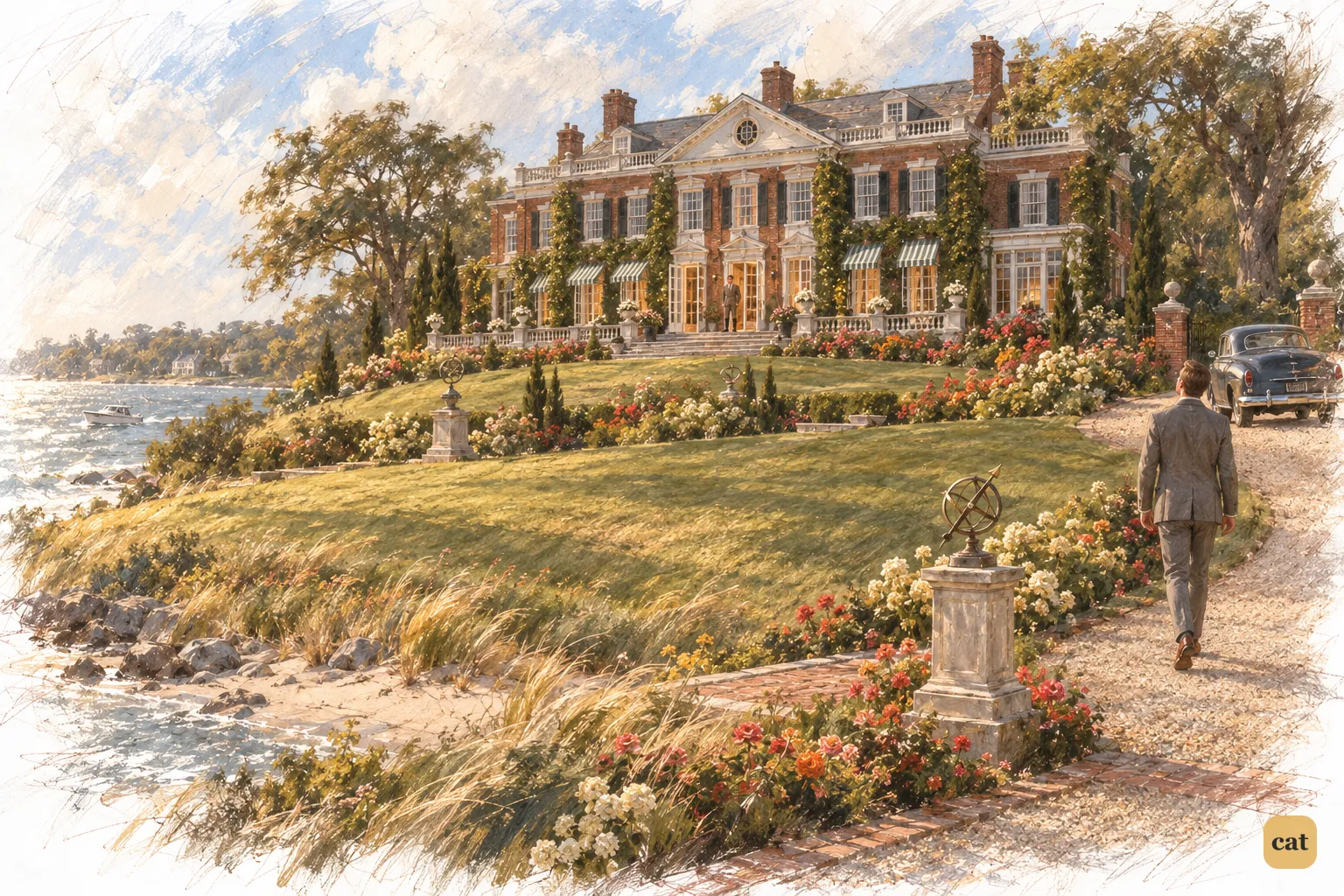
He had changed since his New Haven years. Now he was a sturdy straw-haired man of thirty, with a rather hard mouth and a supercilious manner. Two shining arrogant eyes had established dominance over his face and gave him the appearance of always leaning aggressively forward. Not even the effeminate swank of his riding clothes could hide the enormous power of that body—he seemed to fill those glistening boots until he strained the top lacing, and you could see a great pack of muscle shifting when his shoulder moved under his thin coat. It was a body capable of enormous leverage—a cruel body.

His speaking voice, a gruff husky tenor, added to the impression of fractiousness he conveyed. There was a touch of paternal contempt in it, even toward people he liked—and there were men at New Haven who had hated his guts.
“Now, don’t think my opinion on these matters is final,” he seemed to say, “just because I’m stronger and more of a man than you are.” We were in the same senior society, and while we were never intimate I always had the impression that he approved of me and wanted me to like him with some harsh, defiant wistfulness of his own.
We talked for a few minutes on the sunny porch.
“I’ve got a nice place here,” he said, his eyes flashing about restlessly.
Turning me around by one arm, he moved a broad flat hand along the front vista, including in its sweep a sunken Italian garden, a half acre of deep, pungent roses, and a snub-nosed motorboat that bumped the tide offshore.
“It belonged to Demaine, the oil man.” He turned me around again, politely and abruptly. “We’ll go inside.”
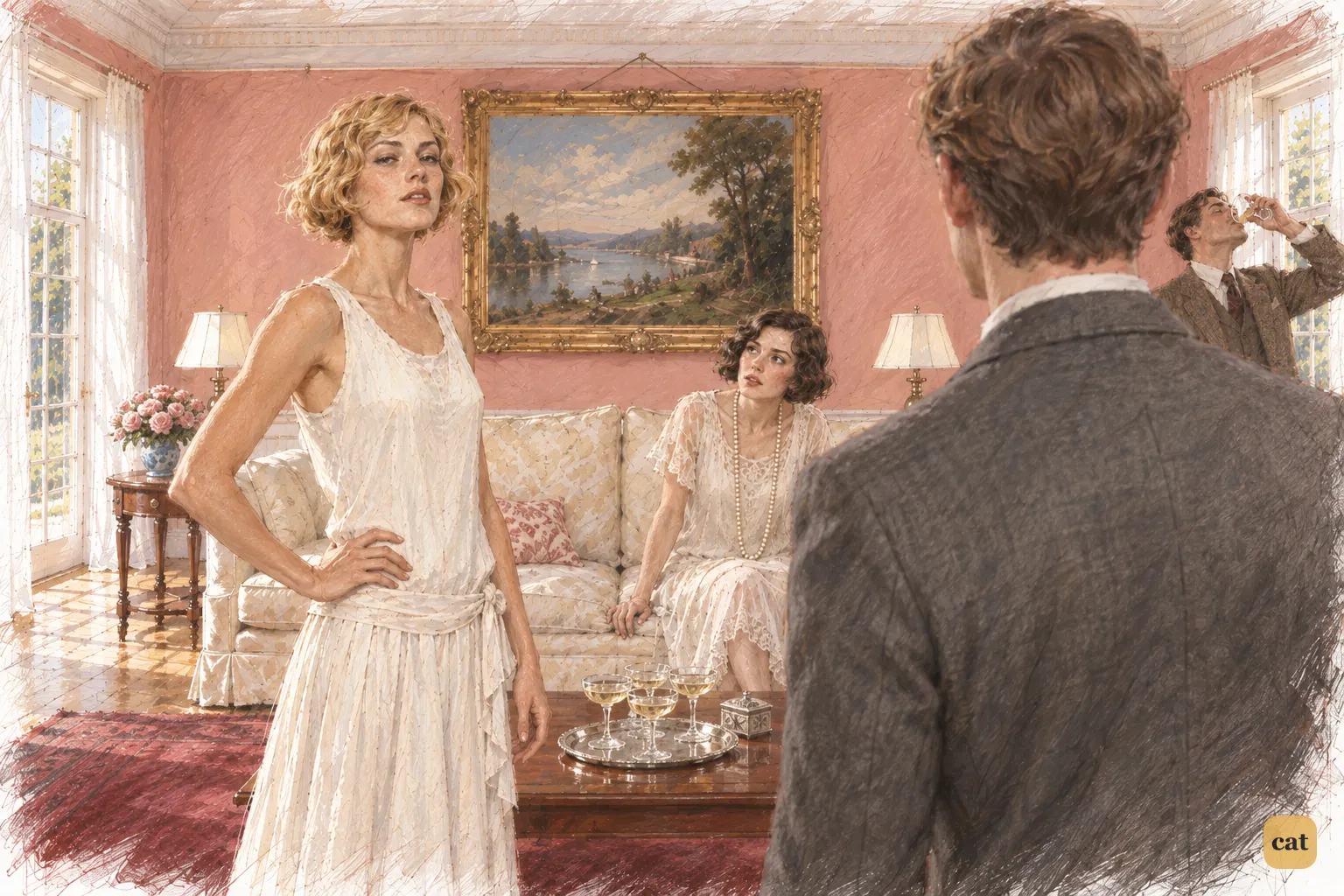
We walked through a high hallway into a bright rosy-coloured space, fragilely bound into the house by French windows at either end. The windows were ajar and gleaming white against the fresh grass outside that seemed to grow a little way into the house. A breeze blew through the room, blew curtains in at one end and out the other like pale flags, twisting them up toward the frosted wedding-cake of the ceiling, and then rippled over the wine-coloured rug, making a shadow on it as wind does on the sea.
The only completely stationary object in the room was an enormous couch on which two young women were buoyed up as though upon an anchored balloon. They were both in white, and their dresses were rippling and fluttering as if they had just been blown back in after a short flight around the house. I must have stood for a few moments listening to the whip and snap of the curtains and the groan of a picture on the wall. Then there was a boom as Tom Buchanan shut the rear windows and the caught wind died out about the room, and the curtains and the rugs and the two young women ballooned slowly to the floor.
The younger of the two was a stranger to me. She was extended full length at her end of the divan, completely motionless, and with her chin raised a little, as if she were balancing something on it which was quite likely to fall. If she saw me out of the corner of her eyes she gave no hint of it—indeed, I was almost surprised into murmuring an apology for having disturbed her by coming in.
The other girl, Daisy, made an attempt to rise—she leaned slightly forward with a conscientious expression—then she laughed, an absurd, charming little laugh, and I laughed too and came forward into the room.
“I’m p-paralysed with happiness.”
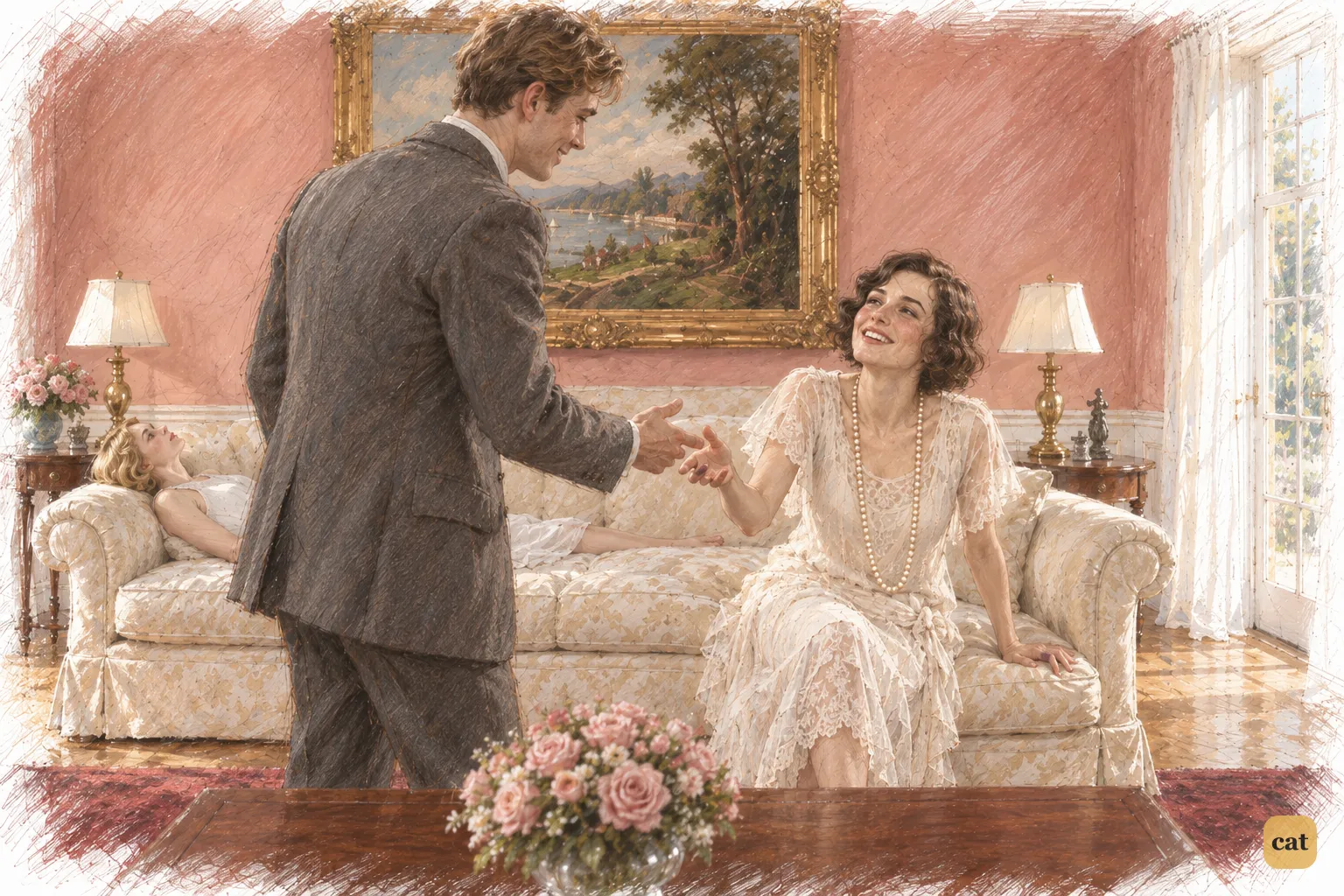
She laughed again, as if she said something very witty, and held my hand for a moment, looking up into my face, promising that there was no one in the world she so much wanted to see. That was a way she had. She hinted in a murmur that the surname of the balancing girl was Baker. (I’ve heard it said that Daisy’s murmur was only to make people lean toward her; an irrelevant criticism that made it no less charming.)
At any rate, Miss Baker’s lips fluttered, she nodded at me almost imperceptibly, and then quickly tipped her head back again—the object she was balancing had obviously tottered a little and given her something of a fright. Again a sort of apology arose to my lips. Almost any exhibition of complete self-sufficiency draws a stunned tribute from me.
I looked back at my cousin, who began to ask me questions in her low, thrilling voice. It was the kind of voice that the ear follows up and down, as if each speech is an arrangement of notes that will never be played again. Her face was sad and lovely with bright things in it, bright eyes and a bright passionate mouth, but there was an excitement in her voice that men who had cared for her found difficult to forget: a singing compulsion, a whispered “Listen,” a promise that she had done gay, exciting things just a while since and that there were gay, exciting things hovering in the next hour.
I told her how I had stopped off in Chicago for a day on my way East, and how a dozen people had sent their love through me.
“Do they miss me?” she cried ecstatically.
“The whole town is desolate. All the cars have the left rear wheel painted black as a mourning wreath, and there’s a persistent wail all night along the north shore.”
“How gorgeous! Let’s go back, Tom. Tomorrow!” Then she added irrelevantly: “You ought to see the baby.”
“I’d like to.”
“She’s asleep. She’s three years old. Haven’t you ever seen her?”
“Never.”
“Well, you ought to see her. She’s—”
Tom Buchanan, who had been hovering restlessly about the room, stopped and rested his hand on my shoulder.
“What you doing, Nick?”
“I’m a bond man.”
“Who with?”
I told him.
“Never heard of them,” he remarked decisively.
This annoyed me.
“You will,” I answered shortly. “You will if you stay in the East.”
“Oh, I’ll stay in the East, don’t you worry,” he said, glancing at Daisy and then back at me, as if he were alert for something more. “I’d be a God damned fool to live anywhere else.”
At this point Miss Baker said: “Absolutely!” with such suddenness that I started—it was the first word she had uttered since I came into the room. Evidently it surprised her as much as it did me, for she yawned and with a series of rapid, deft movements stood up into the room.
“I’m stiff,” she complained, “I’ve been lying on that sofa for as long as I can remember.”
“Don’t look at me,” Daisy retorted, “I’ve been trying to get you to New York all afternoon.”
“No, thanks,” said Miss Baker to the four cocktails just in from the pantry. “I’m absolutely in training.”
Her host looked at her incredulously.
“You are!” He took down his drink as if it were a drop in the bottom of a glass. “How you ever get anything done is beyond me.”
I looked at Miss Baker, wondering what it was she “got done.” I enjoyed looking at her. She was a slender, small-breasted girl, with an erect carriage, which she accentuated by throwing her body backward at the shoulders like a young cadet. Her grey sun-strained eyes looked back at me with polite reciprocal curiosity out of a wan, charming, discontented face. It occurred to me now that I had seen her, or a picture of her, somewhere before.
“You live in West Egg,” she remarked contemptuously. “I know somebody there.”
“I don’t know a single—”
“You must know Gatsby.”
“Gatsby?” demanded Daisy. “What Gatsby?”
Before I could reply that he was my neighbour dinner was announced; wedging his tense arm imperatively under mine, Tom Buchanan compelled me from the room as though he were moving a checker to another square.
Slenderly, languidly, their hands set lightly on their hips, the two young women preceded us out on to a rosy-coloured porch, open toward the sunset, where four candles flickered on the table in the diminished wind.
“Why candles?” objected Daisy, frowning. She snapped them out with her fingers. “In two weeks it’ll be the longest day in the year.” She looked at us all radiantly. “Do you always watch for the longest day of the year and then miss it? I always watch for the longest day in the year and then miss it.”
“We ought to plan something,” yawned Miss Baker, sitting down at the table as if she were getting into bed.
“All right,” said Daisy. “What’ll we plan?” She turned to me helplessly: “What do people plan?”
Before I could answer her eyes fastened with an awed expression on her little finger.
“Look!” she complained; “I hurt it.”
We all looked—the knuckle was black and blue.
“You did it, Tom,” she said accusingly. “I know you didn’t mean to, but you did do it. That’s what I get for marrying a brute of a man, a great, big, hulking physical specimen of a—”
“I hate that word ‘hulking,’ ” objected Tom crossly, “even in kidding.”
“Hulking,” insisted Daisy.
Sometimes she and Miss Baker talked at once, unobtrusively and with a bantering inconsequence that was never quite chatter, that was as cool as their white dresses and their impersonal eyes in the absence of all desire. They were here, and they accepted Tom and me, making only a polite pleasant effort to entertain or to be entertained. They knew that presently dinner would be over and a little later the evening too would be over and casually put away. It was sharply different from the West, where an evening was hurried from phase to phase towards its close, in a continually disappointed anticipation or else in sheer nervous dread of the moment itself.
“You make me feel uncivilized, Daisy,” I confessed on my second glass of corky but rather impressive claret. “Can’t you talk about crops or something?”
I meant nothing in particular by this remark, but it was taken up in an unexpected way.
“Civilization’s going to pieces,” broke out Tom violently. “I’ve gotten to be a terrible pessimist about things. Have you read The Rise of the Coloured Empires by this man Goddard?”
“Why, no,” I answered, rather surprised by his tone.
“Well, it’s a fine book, and everybody ought to read it. The idea is if we don’t look out the white race will be—will be utterly submerged. It’s all scientific stuff; it’s been proved.”
“Tom’s getting very profound,” said Daisy, with an expression of unthoughtful sadness. “He reads deep books with long words in them. What was that word we—”
“Well, these books are all scientific,” insisted Tom, glancing at her impatiently. “This fellow has worked out the whole thing. It’s up to us, who are the dominant race, to watch out or these other races will have control of things.”
“We’ve got to beat them down,” whispered Daisy, winking ferociously toward the fervent sun.
“You ought to live in California—” began Miss Baker, but Tom interrupted her by shifting heavily in his chair.
“This idea is that we’re Nordics. I am, and you are, and you are, and—” After an infinitesimal hesitation he included Daisy with a slight nod, and she winked at me again. “—And we’ve produced all the things that go to make civilization—oh, science and art, and all that. Do you see?”
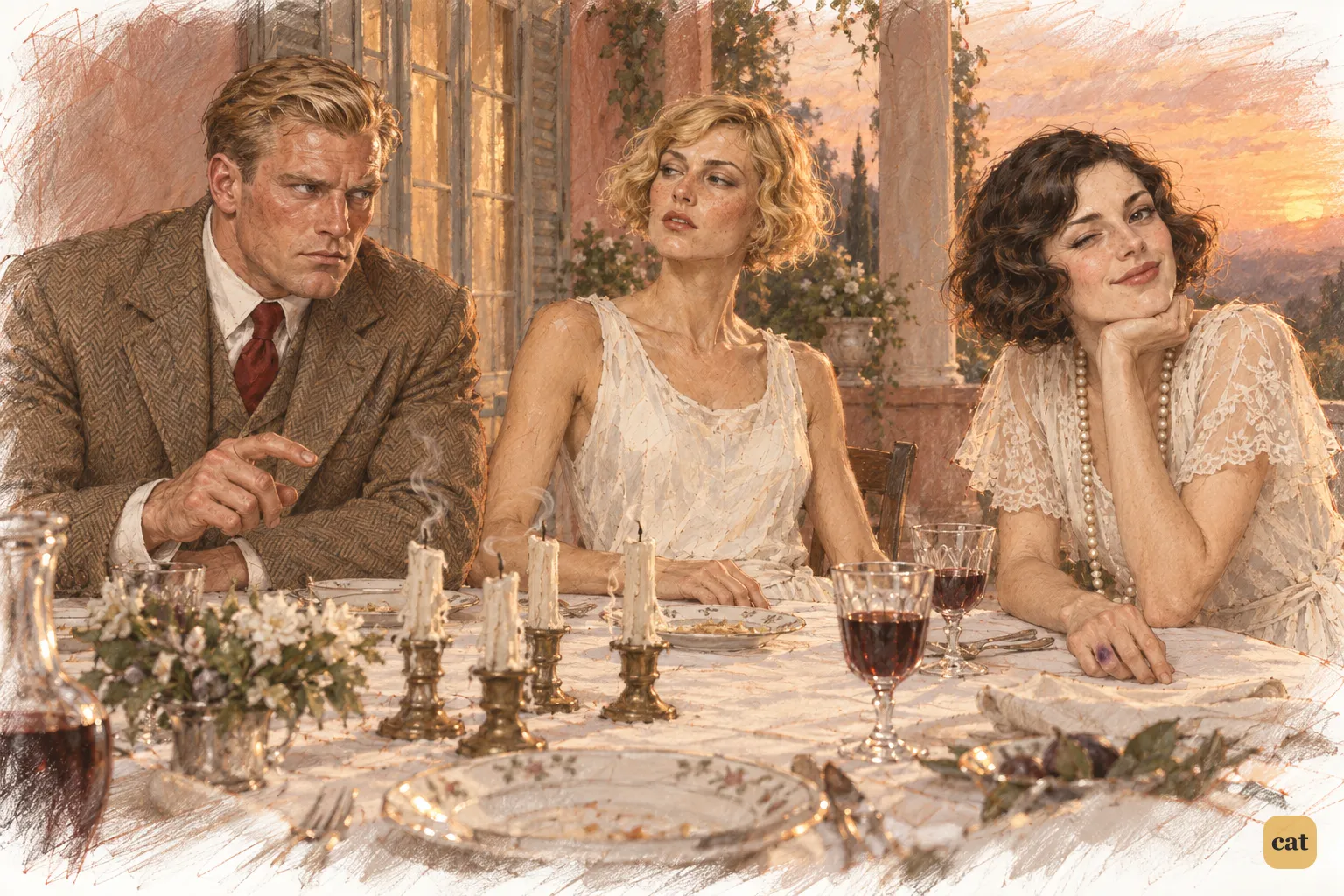
There was something pathetic in his concentration, as if his complacency, more acute than of old, was not enough to him any more. When, almost immediately, the telephone rang inside and the butler left the porch Daisy seized upon the momentary interruption and leaned towards me.
“I’ll tell you a family secret,” she whispered enthusiastically. “It’s about the butler’s nose. Do you want to hear about the butler’s nose?”
“That’s why I came over tonight.”
“Well, he wasn’t always a butler; he used to be the silver polisher for some people in New York that had a silver service for two hundred people. He had to polish it from morning till night, until finally it began to affect his nose—”
“Things went from bad to worse,” suggested Miss Baker.
“Yes. Things went from bad to worse, until finally he had to give up his position.”
For a moment the last sunshine fell with romantic affection upon her glowing face; her voice compelled me forward breathlessly as I listened—then the glow faded, each light deserting her with lingering regret, like children leaving a pleasant street at dusk.
The butler came back and murmured something close to Tom’s ear, whereupon Tom frowned, pushed back his chair, and without a word went inside. As if his absence quickened something within her, Daisy leaned forward again, her voice glowing and singing.
“I love to see you at my table, Nick. You remind me of a—of a rose, an absolute rose. Doesn’t he?” She turned to Miss Baker for confirmation: “An absolute rose?”
This was untrue. I am not even faintly like a rose. She was only extemporizing, but a stirring warmth flowed from her, as if her heart was trying to come out to you concealed in one of those breathless, thrilling words. Then suddenly she threw her napkin on the table and excused herself and went into the house.
Miss Baker and I exchanged a short glance consciously devoid of meaning. I was about to speak when she sat up alertly and said “Sh!” in a warning voice. A subdued impassioned murmur was audible in the room beyond, and Miss Baker leaned forward unashamed, trying to hear. The murmur trembled on the verge of coherence, sank down, mounted excitedly, and then ceased altogether.
“This Mr. Gatsby you spoke of is my neighbour—” I began.
“Don’t talk. I want to hear what happens.”
“Is something happening?” I inquired innocently.
“You mean to say you don’t know?” said Miss Baker, honestly surprised. “I thought everybody knew.”
“I don’t.”
“Why—” she said hesitantly. “Tom’s got some woman in New York.”

“Got some woman?” I repeated blankly.
Miss Baker nodded.
“She might have the decency not to telephone him at dinner time. Don’t you think?”
Almost before I had grasped her meaning there was the flutter of a dress and the crunch of leather boots, and Tom and Daisy were back at the table.
“It couldn’t be helped!” cried Daisy with tense gaiety.
She sat down, glanced searchingly at Miss Baker and then at me, and continued: “I looked outdoors for a minute, and it’s very romantic outdoors. There’s a bird on the lawn that I think must be a nightingale come over on the Cunard or White Star Line. He’s singing away—” Her voice sang: “It’s romantic, isn’t it, Tom?”
“Very romantic,” he said, and then miserably to me: “If it’s light enough after dinner, I want to take you down to the stables.”
The telephone rang inside, startlingly, and as Daisy shook her head decisively at Tom the subject of the stables, in fact all subjects, vanished into air. Among the broken fragments of the last five minutes at table I remember the candles being lit again, pointlessly, and I was conscious of wanting to look squarely at everyone, and yet to avoid all eyes. I couldn’t guess what Daisy and Tom were thinking, but I doubt if even Miss Baker, who seemed to have mastered a certain hardy scepticism, was able utterly to put this fifth guest’s shrill metallic urgency out of mind. To a certain temperament the situation might have seemed intriguing—my own instinct was to telephone immediately for the police.
The horses, needless to say, were not mentioned again. Tom and Miss Baker, with several feet of twilight between them, strolled back into the library, as if to a vigil beside a perfectly tangible body, while, trying to look pleasantly interested and a little deaf, I followed Daisy around a chain of connecting verandas to the porch in front. In its deep gloom we sat down side by side on a wicker settee.
Daisy took her face in her hands as if feeling its lovely shape, and her eyes moved gradually out into the velvet dusk. I saw that turbulent emotions possessed her, so I asked what I thought would be some sedative questions about her little girl.
“We don’t know each other very well, Nick,” she said suddenly. “Even if we are cousins. You didn’t come to my wedding.”
“I wasn’t back from the war.”
“That’s true.” She hesitated. “Well, I’ve had a very bad time, Nick, and I’m pretty cynical about everything.”
Evidently she had reason to be. I waited but she didn’t say any more, and after a moment I returned rather feebly to the subject of her daughter.
“I suppose she talks, and—eats, and everything.”
“Oh, yes.” She looked at me absently. “Listen, Nick; let me tell you what I said when she was born. Would you like to hear?”
“Very much.”
“It’ll show you how I’ve gotten to feel about—things. Well, she was less than an hour old and Tom was God knows where. I woke up out of the ether with an utterly abandoned feeling, and asked the nurse right away if it was a boy or a girl. She told me it was a girl, and so I turned my head away and wept. ‘All right,’ I said, ‘I’m glad it’s a girl. And I hope she’ll be a fool—that’s the best thing a girl can be in this world, a beautiful little fool.’
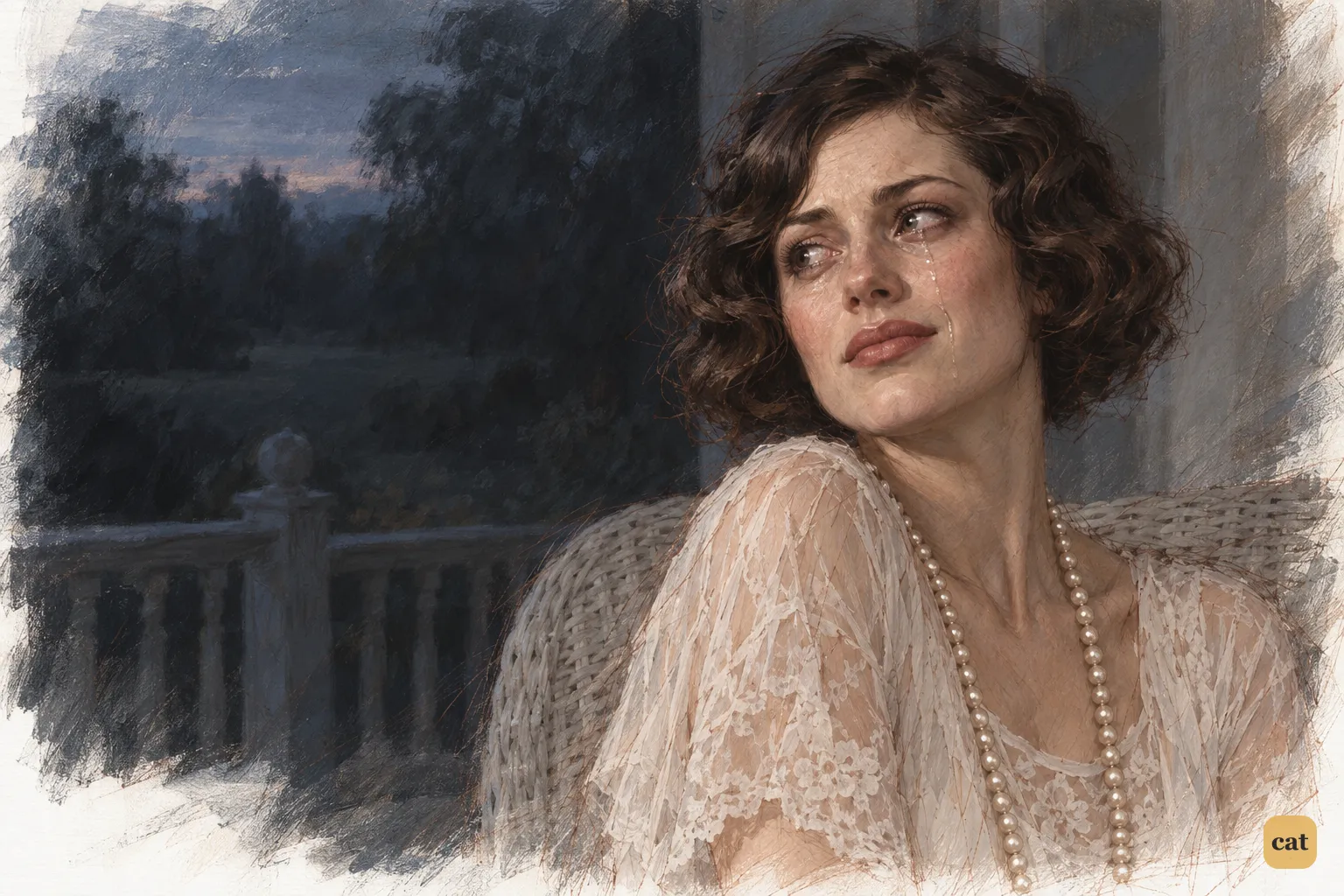
“You see I think everything’s terrible anyhow,” she went on in a convinced way. “Everybody thinks so—the most advanced people. And I know. I’ve been everywhere and seen everything and done everything.” Her eyes flashed around her in a defiant way, rather like Tom’s, and she laughed with thrilling scorn. “Sophisticated—God, I’m sophisticated!”
The instant her voice broke off, ceasing to compel my attention, my belief, I felt the basic insincerity of what she had said. It made me uneasy, as though the whole evening had been a trick of some sort to exact a contributory emotion from me. I waited, and sure enough, in a moment she looked at me with an absolute smirk on her lovely face, as if she had asserted her membership in a rather distinguished secret society to which she and Tom belonged.
————————————————————————————————————
Inside, the crimson room bloomed with light. Tom and Miss Baker sat at either end of the long couch and she read aloud to him from the Saturday Evening Post—the words, murmurous and uninflected, running together in a soothing tune. The lamplight, bright on his boots and dull on the autumn-leaf yellow of her hair, glinted along the paper as she turned a page with a flutter of slender muscles in her arms.
When we came in she held us silent for a moment with a lifted hand.
“To be continued,” she said, tossing the magazine on the table, “in our very next issue.”
Her body asserted itself with a restless movement of her knee, and she stood up.
“Ten o’clock,” she remarked, apparently finding the time on the ceiling. “Time for this good girl to go to bed.”
“Jordan’s going to play in the tournament tomorrow,” explained Daisy, “over at Westchester.”
“Oh—you’re Jordan Baker.”
I knew now why her face was familiar—its pleasing contemptuous expression had looked out at me from many rotogravure pictures of the sporting life at Asheville and Hot Springs and Palm Beach. I had heard some story of her too, a critical, unpleasant story, but what it was I had forgotten long ago.
“Good night,” she said softly. “Wake me at eight, won’t you.”
“If you’ll get up.”
“I will. Good night, Mr. Carraway. See you anon.”
“Of course you will,” confirmed Daisy. “In fact I think I’ll arrange a marriage. Come over often, Nick, and I’ll sort of—oh—fling you together. You know—lock you up accidentally in linen closets and push you out to sea in a boat, and all that sort of thing—”
“Good night,” called Miss Baker from the stairs. “I haven’t heard a word.”
“She’s a nice girl,” said Tom after a moment. “They oughtn’t to let her run around the country this way.”
“Who oughtn’t to?” inquired Daisy coldly.
“Her family.”
“Her family is one aunt about a thousand years old. Besides, Nick’s going to look after her, aren’t you, Nick? She’s going to spend lots of weekends out here this summer. I think the home influence will be very good for her.”
Daisy and Tom looked at each other for a moment in silence.
“Is she from New York?” I asked quickly.
“From Louisville. Our white girlhood was passed together there. Our beautiful white—”
“Did you give Nick a little heart to heart talk on the veranda?” demanded Tom suddenly.
“Did I?” She looked at me. “I can’t seem to remember, but I think we talked about the Nordic race. Yes, I’m sure we did. It sort of crept up on us and first thing you know—”
“Don’t believe everything you hear, Nick,” he advised me.
I said lightly that I had heard nothing at all, and a few minutes later I got up to go home. They came to the door with me and stood side by side in a cheerful square of light. As I started my motor Daisy peremptorily called: “Wait!
“I forgot to ask you something, and it’s important. We heard you were engaged to a girl out West.”
“That’s right,” corroborated Tom kindly. “We heard that you were engaged.”
“It’s a libel. I’m too poor.”
“But we heard it,” insisted Daisy, surprising me by opening up again in a flower-like way. “We heard it from three people, so it must be true.”
Of course I knew what they were referring to, but I wasn’t even vaguely engaged. The fact that gossip had published the banns was one of the reasons I had come East. You can’t stop going with an old friend on account of rumours, and on the other hand I had no intention of being rumoured into marriage.
Their interest rather touched me and made them less remotely rich—nevertheless, I was confused and a little disgusted as I drove away. It seemed to me that the thing for Daisy to do was to rush out of the house, child in arms—but apparently there were no such intentions in her head. As for Tom, the fact that he “had some woman in New York” was really less surprising than that he had been depressed by a book. Something was making him nibble at the edge of stale ideas as if his sturdy physical egotism no longer nourished his peremptory heart.
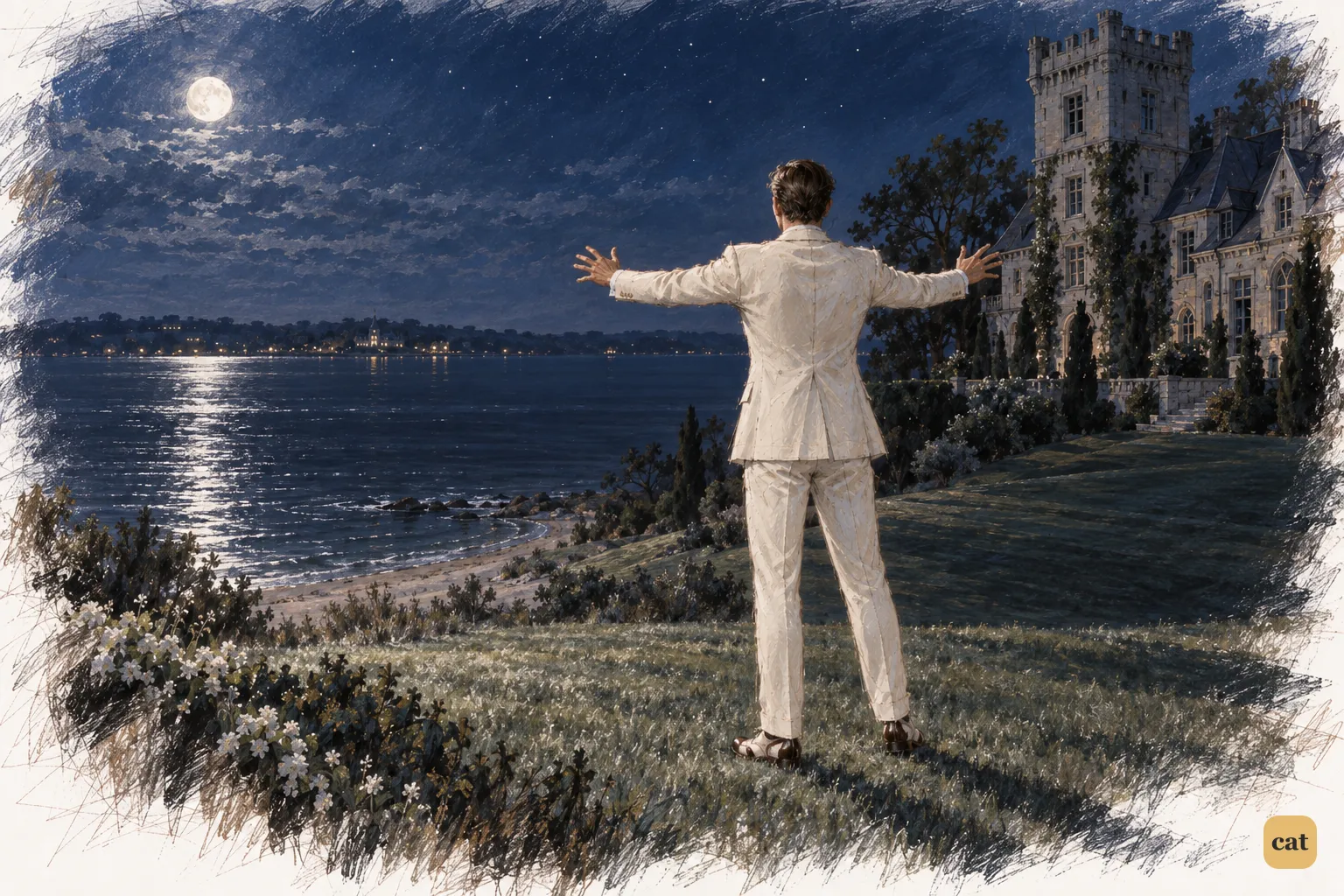
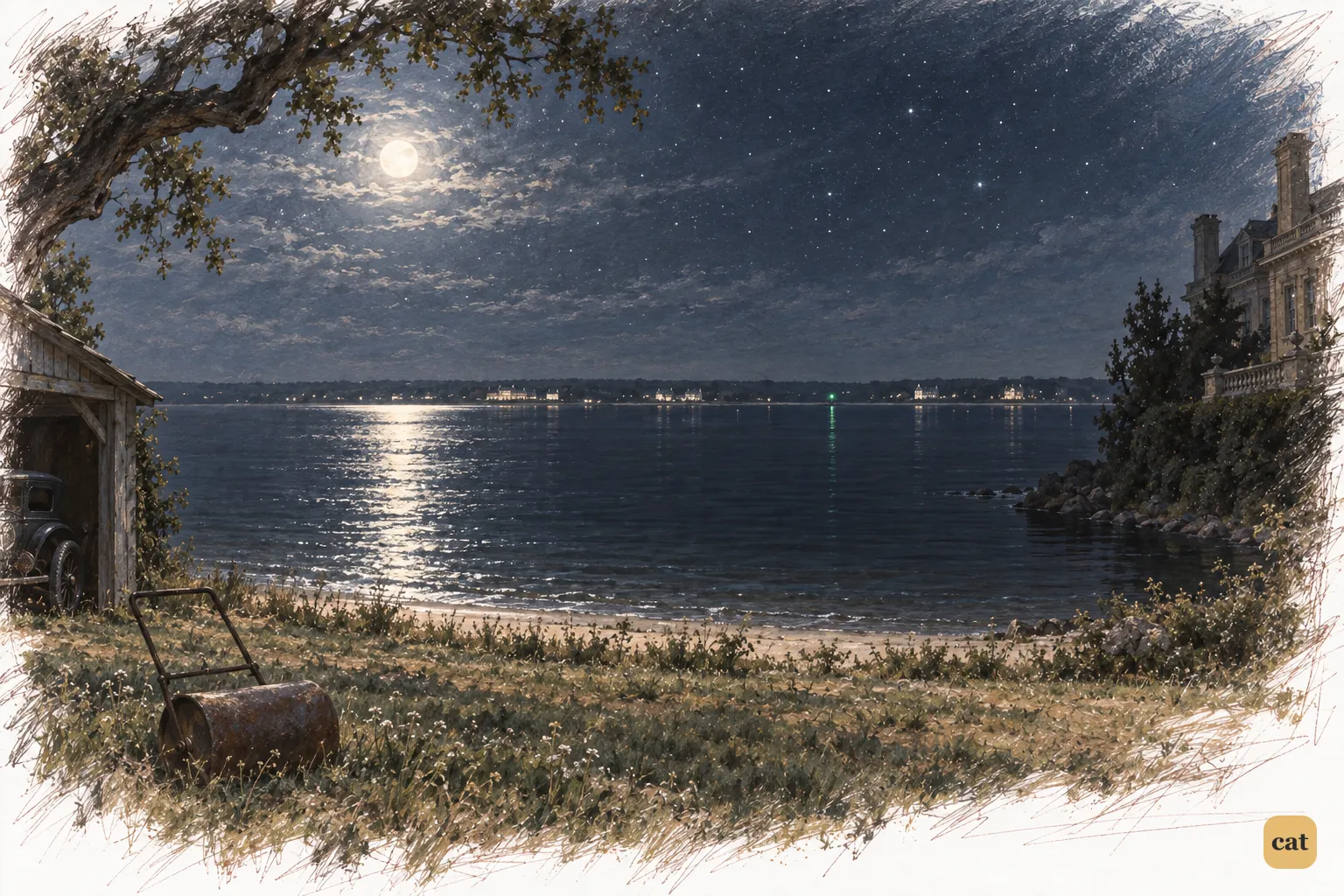
Already it was deep summer on roadhouse roofs and in front of wayside garages, where new red petrol-pumps sat out in pools of light, and when I reached my estate at West Egg I ran the car under its shed and sat for a while on an abandoned grass roller in the yard. The wind had blown off, leaving a loud, bright night, with wings beating in the trees and a persistent organ sound as the full bellows of the earth blew the frogs full of life. The silhouette of a moving cat wavered across the moonlight, and, turning my head to watch it, I saw that I was not alone—fifty feet away a figure had emerged from the shadow of my neighbour’s mansion and was standing with his hands in his pockets regarding the silver pepper of the stars. Something in his leisurely movements and the secure position of his feet upon the lawn suggested that it was Mr. Gatsby himself, come out to determine what share was his of our local heavens.
I decided to call to him. Miss Baker had mentioned him at dinner, and that would do for an introduction. But I didn’t call to him, for he gave a sudden intimation that he was content to be alone—he stretched out his arms toward the dark water in a curious way, and, far as I was from him, I could have sworn he was trembling. Involuntarily I glanced seaward—and distinguished nothing except a single green light, minute and far away, that might have been the end of a dock. When I looked once more for Gatsby he had vanished, and I was alone again in the unquiet darkness.