 Author
-

Belrive across the lake
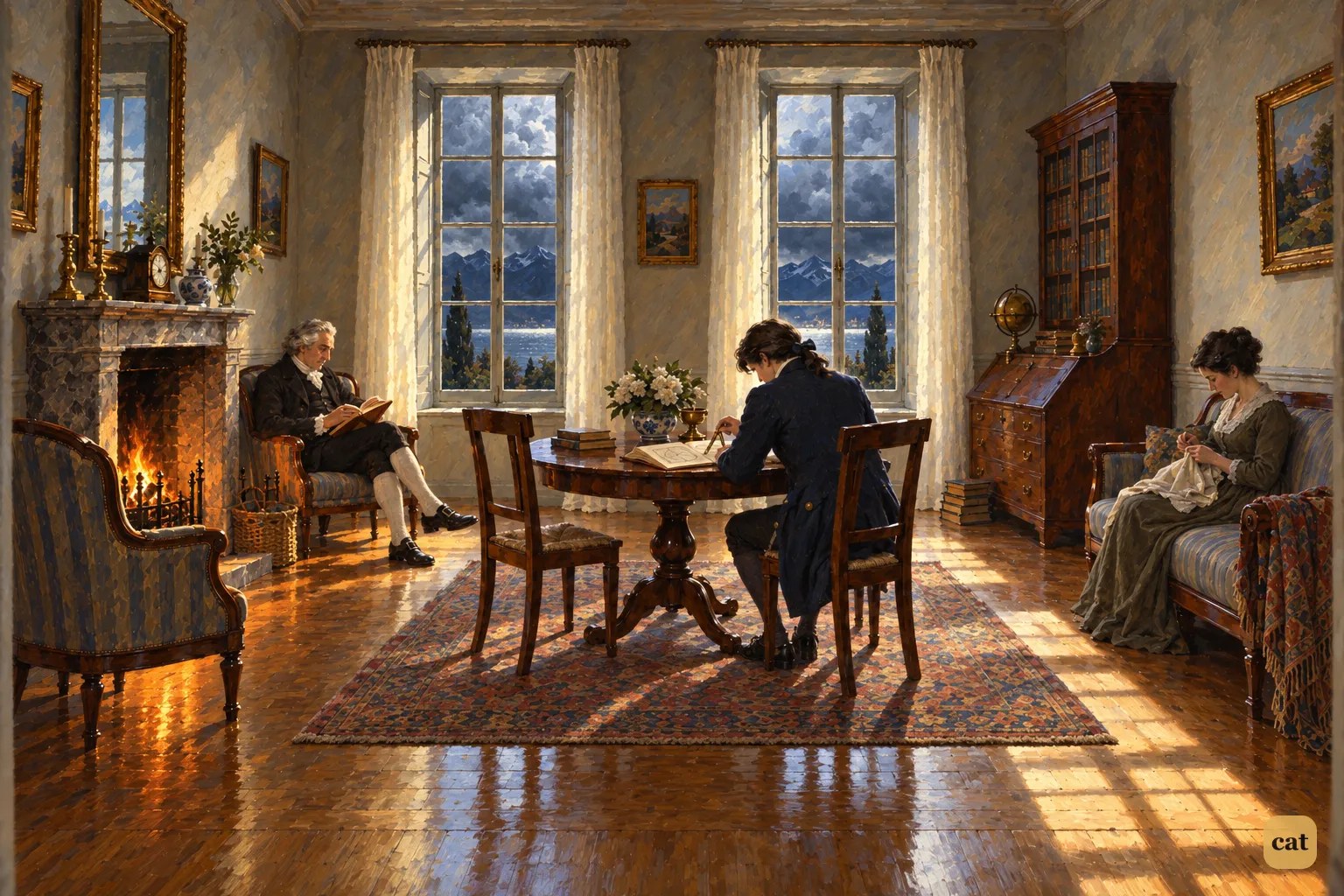
We were brought up together; there was not quite a year difference in our ages. I need not say that we were strangers to any species of disunion or dispute. Harmony was the soul of our companionship, and the diversity and contrast that subsisted in our characters drew us nearer together. Elizabeth was of a calmer and more concentrated disposition; but, with all my ardour, I was capable of a more intense application and was more deeply smitten with the thirst for knowledge. She busied herself with following the aerial creations of the poets; and in the majestic and wondrous scenes which surrounded our Swiss home —the sublime shapes of the mountains, the changes of the seasons, tempest and calm, the silence of winter, and the life and turbulence of our Alpine summers—she found ample scope for admiration and delight. While my companion contemplated with a serious and satisfied spirit the magnificent appearances of things, I delighted in investigating their causes. The world was to me a secret which I desired to divine. Curiosity, earnest research to learn the hidden laws of nature, gladness akin to rapture, as they were unfolded to me, are among the earliest sensations I can remember.
Read from here → -

Clerval's play of knights
On the birth of a second son, my junior by seven years, my parents gave up entirely their wandering life and fixed themselves in their native country. We possessed a house in Geneva, and a campagne on Belrive, the eastern shore of the lake, at the distance of rather more than a league from the city. We resided principally in the latter, and the lives of my parents were passed in considerable seclusion. It was my temper to avoid a crowd and to attach myself fervently to a few. I was indifferent, therefore, to my school-fellows in general; but I united myself in the bonds of the closest friendship to one among them. Henry Clerval was the son of a merchant of Geneva. He was a boy of singular talent and fancy. He loved enterprise, hardship, and even danger for its own sake. He was deeply read in books of chivalry and romance. He composed heroic songs and began to write many a tale of enchantment and knightly adventure. He tried to make us act plays and to enter into masquerades, in which the characters were drawn from the heroes of Roncesvalles, of the Round Table of King Arthur, and the chivalrous train who shed their blood to redeem the holy sepulchre from the hands of the infidels.
Read from here → -

Elizabeth's gentling hand
Meanwhile Clerval occupied himself, so to speak, with the moral relations of things. The busy stage of life, the virtues of heroes, and the actions of men were his theme; and his hope and his dream was to become one among those whose names are recorded in story as the gallant and adventurous benefactors of our species. The saintly soul of Elizabeth shone like a shrine-dedicated lamp in our peaceful home. Her sympathy was ours; her smile, her soft voice, the sweet glance of her celestial eyes, were ever there to bless and animate us. She was the living spirit of love to soften and attract; I might have become sullen in my study, rough through the ardour of my nature, but that she was there to subdue me to a semblance of her own gentleness. And Clerval—could aught ill entrench on the noble spirit of Clerval? Yet he might not have been so perfectly humane, so thoughtful in his generosity, so full of kindness and tenderness amidst his passion for adventurous exploit, had she not unfolded to him the real loveliness of beneficence and made the doing good the end and aim of his soaring ambition.
Read from here → -
"It is sad trash"
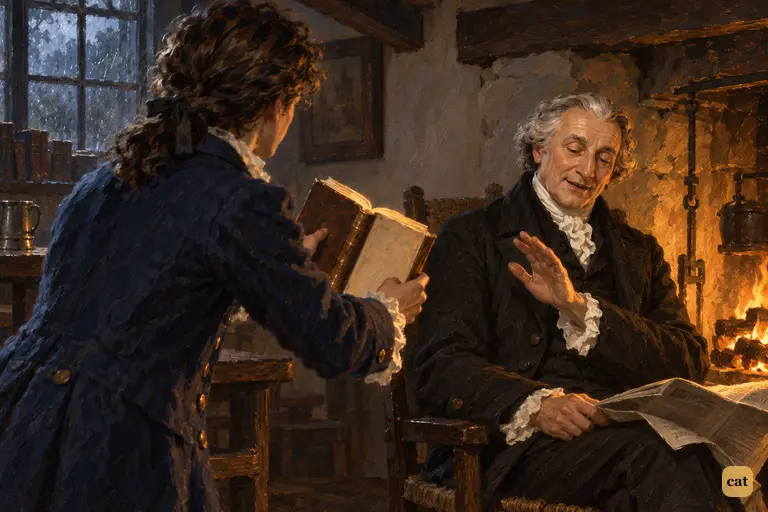
Natural philosophy is the genius that has regulated my fate; I desire, therefore, in this narration, to state those facts which led to my predilection for that science. When I was thirteen years of age we all went on a party of pleasure to the baths near Thonon; the inclemency of the weather obliged us to remain a day confined to the inn. In this house I chanced to find a volume of the works of Cornelius Agrippa. I opened it with apathy; the theory which he attempts to demonstrate and the wonderful facts which he relates soon changed this feeling into enthusiasm. A new light seemed to dawn upon my mind, and bounding with joy, I communicated my discovery to my father. My father looked carelessly at the title page of my book and said, “Ah! Cornelius Agrippa! My dear Victor, do not waste your time upon this; it is sad trash.”
Read from here → -

The failed incantation
Nor were these my only visions. The raising of ghosts or devils was a promise liberally accorded by my favourite authors, the fulfilment of which I most eagerly sought; and if my incantations were always unsuccessful, I attributed the failure rather to my own inexperience and mistake than to a want of skill or fidelity in my instructors. And thus for a time I was occupied by exploded systems, mingling, like an unadept, a thousand contradictory theories and floundering desperately in a very slough of multifarious knowledge, guided by an ardent imagination and childish reasoning, till an accident again changed the current of my ideas.
Read from here → -

Ribbons of wood
When I was about fifteen years old we had retired to our house near Belrive, when we witnessed a most violent and terrible thunderstorm. It advanced from behind the mountains of Jura, and the thunder burst at once with frightful loudness from various quarters of the heavens. I remained, while the storm lasted, watching its progress with curiosity and delight. As I stood at the door, on a sudden I beheld a stream of fire issue from an old and beautiful oak which stood about twenty yards from our house; and so soon as the dazzling light vanished, the oak had disappeared, and nothing remained but a blasted stump. When we visited it the next morning, we found the tree shattered in a singular manner. It was not splintered by the shock, but entirely reduced to thin ribbons of wood. I never beheld anything so utterly destroyed.
Read from here → -
Destiny gathers
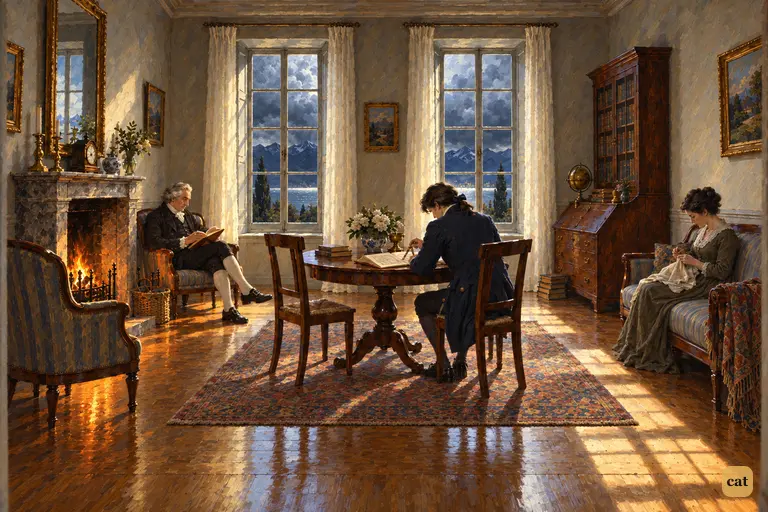
It was a strong effort of the spirit of good, but it was ineffectual. Destiny was too potent, and her immutable laws had decreed my utter and terrible destruction.
Read from here → -
Chapter 5
Agrippa, the lightning, and the seeds of ruin
Next chapter: Mother's death and Waldman's lecture Read this chapter